The low autumn sun stipples green-blurred branches.
Chatter, trains, bells: the vibe alive.
A group of women and tourists stand amazed,
Joyed-up by childish discovery.
Disbelieving they show their friends:
A mouse moves under a bench.
This city:
rich-mucked, new yet old.
The bell-ringers’ unashamed practice.
Jaunty hats play in a sea of gold-flushed slanting forearms,
straightened hair and oversized sunglasses.
At trashy pink tables,
speakers,
eaters,
writers,
eavesdroppers
absorb and expel.
Fish and chips,
glass-bottled coke.
Moustaches, scarves, yellow tights.
Accoutrements of show and feel.
Trains swerve out of view only,
revealing glimpses, betrayed by their crash and squeak.
The bells peal kinaesthetically;
scales falling like sunlight,
auditory confetti,
3-D campanology.
An octave and a half, relentlessly tipping and tumbling down,
a confusion of light in a race to the ground,
reliably always arriving.
The sun chimes out its warmth across convex cobbles.
It was always so, may it always be so.
Bouncing hair and shock-pink grins,
practical jokes, beardy discussions,
epithets and inscriptions deep-cut.
Deafening light, blinding noise;
eyes, ears, heart.
Only blood moves the heart;
Only blood leaves the heart unmoved.
The bells’ scale has rioted:
leaping, loping, pealing,
resolved unsystematically,
book-ended by octaves.
Gradually slowing,
it becomes the five o’clock bell.
Time to go,
in body,
but never in spirit.
Sunday, 22 November 2009


On Williamsburg Bridge, Tuesday 13th October 2009

Rich handpainted view, a moving freeze-frame. Superfine definition creates illusory motion. Every pixel coming forward, coming out. Real has become hyper-real, vivid, false. It has been veiled in the bright sunlight of consciousness. In the end the most beautiful thing is to be conscious.
The city's too-close horizon an urban Rousseau of vertice and plane. Winking gilded roofs peep out, sun-blasted brownstone blocks chessman-neat. Distant thunderstorms rollock and billow.


Saturday, 14 November 2009
An Introduction to The Humanist Bible Project
Let us assume that there is no God: that this is a given of existence. A crumb-collecting theologian may want an inquest to decide if its death was murder, old age, suicide or most likely, an antediluvian stillborn.
A question for the humanist is: what we can make of the great works of art and wisdom inspired by this God? They were certainly created by people in commune with a sense of the beyond, a mysterious compulsion that they named God. This God was perhaps a convenient explanation of their super-human powers, as if they were embarrassed to admit themselves capable of the staggering fertility of their imaginations, the towering intellect and insight whose flashes they could transcribe into music and art. So God is perhaps best described as an alibi; a colossal self-denial. We had the divine in us, were ashamed, and assigned it elsewhere. We excised perfection from humanity and called that perfection the divine. The divine is the fearful perceived impossibility of authentic perfection: the non-human, the meta-human, the über-human. Yet there is only human.
God is a human concept. Everything we assign to it signifies some human depth. The inspiration from God comes only from within. The messages and morals come from inside humans. Like the Greek Myths, all religious stories are necessarily and in every way about us. Every tale that resonates with us is one in which we see ourselves reflected, as in a glass, darkly (1 Corinthians 13). Freud found in the Oedipus myth a cipher of human desires. Camus saw in the myth of Sisyphus a manifestation of our own sense of endless futility. Whether or not done consciously, these ancient stories strive towards self-understanding. The same can be said of Shakespeare: we needn't attempt to unravel Hamlet's actions to know that somehow he is the everyman; his struggle his not explicable, but is utterly and terrifyingly knowable. Something, in the words of Beethoven, "which comprehends mankind but which mankind cannot comprehend."
Is it not time to decipher ourselves through the prism the greatest story ever told: The Bible? To reinvent parable as myth?
The Bible stumbles on weighed down by a dead God hanging like an albatross from its neck. It should be saved and put in its place not as a devotional text, but as a psychological work of art. The Bible must be rescued, not thrown out with the bathwater of organised religion. Remove God, and we are presented with a solely human work, a work comprised of tales of greed, love, avarice, calumny, sacrifice, wisdom and art probably unparalleled in any other single text. God must be recognised as a placeholder, and re-signified as a mortal intention of the human psyche.
As an example, the story of Abraham and Isaac. In it we learn that God is a manically jealous deity, perhaps a practical-joker. Without God, these parables can become riddles of human psychology, instead of endless ruminations on the vagaries of a fantastical beardied lunatic. Perhaps we see Freud here: the father is jealous of the son and seeks to kill him. It could reflect the inexplicable instinct to destory that which we love , or perhaps our endless intoxification with danger and violence. Is this a challenge which we all face everyday - the effort not to kill those around us? Man is both a proud and yet a wretched thing.
Humans wrote every word in the Bible: unearthed every psychological truth, had every mystic revelation, created every heart-stopping metaphor, grappled with the terrifying and uncompromising truths of existence and constructed a place for mankind in a seemingly chaotic world: it’s time to take sole credit for this achievement: to acknowledge the human divine. I would like to see a Bible stripped completely of its devotional elements, with God on the cutting room floor, and left as a book of human wisdom and human art.
Time to make an atheist’s Bible of pure literature, untainted by the stain of religious association. The aim is not to explain or understand what the writers of the Bible were implying, but just to render them accessible, to allow their words to emerge from under the veil of faith.
Anyone who is interested in joining in, do so: the aspiration is to become open-source.
A question for the humanist is: what we can make of the great works of art and wisdom inspired by this God? They were certainly created by people in commune with a sense of the beyond, a mysterious compulsion that they named God. This God was perhaps a convenient explanation of their super-human powers, as if they were embarrassed to admit themselves capable of the staggering fertility of their imaginations, the towering intellect and insight whose flashes they could transcribe into music and art. So God is perhaps best described as an alibi; a colossal self-denial. We had the divine in us, were ashamed, and assigned it elsewhere. We excised perfection from humanity and called that perfection the divine. The divine is the fearful perceived impossibility of authentic perfection: the non-human, the meta-human, the über-human. Yet there is only human.
God is a human concept. Everything we assign to it signifies some human depth. The inspiration from God comes only from within. The messages and morals come from inside humans. Like the Greek Myths, all religious stories are necessarily and in every way about us. Every tale that resonates with us is one in which we see ourselves reflected, as in a glass, darkly (1 Corinthians 13). Freud found in the Oedipus myth a cipher of human desires. Camus saw in the myth of Sisyphus a manifestation of our own sense of endless futility. Whether or not done consciously, these ancient stories strive towards self-understanding. The same can be said of Shakespeare: we needn't attempt to unravel Hamlet's actions to know that somehow he is the everyman; his struggle his not explicable, but is utterly and terrifyingly knowable. Something, in the words of Beethoven, "which comprehends mankind but which mankind cannot comprehend."
Is it not time to decipher ourselves through the prism the greatest story ever told: The Bible? To reinvent parable as myth?
The Bible stumbles on weighed down by a dead God hanging like an albatross from its neck. It should be saved and put in its place not as a devotional text, but as a psychological work of art. The Bible must be rescued, not thrown out with the bathwater of organised religion. Remove God, and we are presented with a solely human work, a work comprised of tales of greed, love, avarice, calumny, sacrifice, wisdom and art probably unparalleled in any other single text. God must be recognised as a placeholder, and re-signified as a mortal intention of the human psyche.
As an example, the story of Abraham and Isaac. In it we learn that God is a manically jealous deity, perhaps a practical-joker. Without God, these parables can become riddles of human psychology, instead of endless ruminations on the vagaries of a fantastical beardied lunatic. Perhaps we see Freud here: the father is jealous of the son and seeks to kill him. It could reflect the inexplicable instinct to destory that which we love , or perhaps our endless intoxification with danger and violence. Is this a challenge which we all face everyday - the effort not to kill those around us? Man is both a proud and yet a wretched thing.
Humans wrote every word in the Bible: unearthed every psychological truth, had every mystic revelation, created every heart-stopping metaphor, grappled with the terrifying and uncompromising truths of existence and constructed a place for mankind in a seemingly chaotic world: it’s time to take sole credit for this achievement: to acknowledge the human divine. I would like to see a Bible stripped completely of its devotional elements, with God on the cutting room floor, and left as a book of human wisdom and human art.
Time to make an atheist’s Bible of pure literature, untainted by the stain of religious association. The aim is not to explain or understand what the writers of the Bible were implying, but just to render them accessible, to allow their words to emerge from under the veil of faith.
Anyone who is interested in joining in, do so: the aspiration is to become open-source.
Monday, 26 October 2009
Downtown New York
Without the Twin Towers, Downtown New York is barely recognizable. Its dumpy oblong skyscrapers could be anywhere – Phoenix, Atlanta, Vancouver, Miami, Seattle, even Bogotá. Along with the Empire State Building, they were the defining insignia, the animistic totem of the tribe of New Yorkers. Now, Downtown could be anywhere, anyone’s.
Which is which?


Which is which? Answers at the bottom of this post.
The city’s identity is saved by the Empire State Building in Midtown, and the monumentally over-sized bridges of the East River. These symbols retain the distinctive arrogance of the new imperialism, as the palaces of London, Paris and Vienna manifest the contempt of the wealthy imperialist for his pillaged colonies.
Architecturally, in New York’s loss, we can see the indispensability of enduring landmark buildings in the definition of location. It is these iconic buildings which should reflect the people for whom they become a landscape, a permanent backdrop, and in reflecting them, also represent them symbolically, become their identity. Egypt and the Pyramids, Paris and La Tour Eiffel and Notre Dame, London has many defining landmarks – Tower Bridge, The Palace of Westminster perhaps above all. Thus architects have a responsibility to those in whose backyards they build – a responsibility of psychological affiliation. They must not construct their own personal visions, but use their vision to sum up the enduring and possibly concealed identity of the citizens and inhabitants of those places. These icons must be built to last, as a civilization’s identity lasts longer than the lifetime of one of its inhabitants. My identity as a Londoner comes in great part from absorbing a sense of myself through my surroundings: the River Thames, St Paul’s Cathedral, the Palace of Westminster, the BT Tower, Canary Wharf, views from Hampstead Heath and Kenwood House, Tower Bridge, the Eye, Westway, St Pancras; equally the future “identity”, inasmuch as such a thing exists, of future Londoners will continue to be fashioned by these same influences.
This necessity, for endurance and quality, must be in the forefront of an architect’s mind: will it last? is it a gift to the future of its setting? will it become part of the identity of its place? can it become its location? The swagger of riches, the two-fingered salute to socialism that the Twin Towers were, could only exist in New York, and so naturally came to be an allegory for the city.

The Twin Towers were a timely emblem for New York and for New Yorkers. They perfectly pre-empted and went on to represent the phenomenal financial success of the 80s, they were a temple to the values of the modern capitalist paradigm. Like a symbol such as St Peter’s in Rome, they could be seen all over the city – a moral certainty, a harbinger of the new meritocracy, a reflection of what the city stood for, evidence that bigger was better. They were also what New York was to the world – confident, wealthy, brash, fearful, oversized, defiant, exhilarating.
Psychologically, psychoanalytically, Downtown Manhattan was castrated on 11/09. In "The Future Prospects of Psycho-Analytic Therapy" (1910, p144), Freud states that the child is “in fear of the father, in defiance of the father and in disbelief of the father.” This child wants both to ape his father, but also kill or castrate him. The instinctive urges of the child - of an adolescent civilization - attacked from envy what it both hates and yet aspires to be: a strong and self-determining civilization. This “father” (in this case perhaps an uncle – Uncle Sam) is powerful and vengeful, it can both bestow and withhold, save and destroy, punish and reward. Since 2001, America has reinforced the relationship of an inconsistent father alternately criticising and spoiling an angry juvenile son. Through retributions, wars, invasions and threats it punishes; simultaneously it rewards: cajoling, sweetening, rebuilding and making promises, expecting to raise the rest of the world in its own dysfunctional image, like a parent filling its child with all the faults it had.
Photos are, from top: Seattle, Miami, New York, Vancouver, Bogotá, Atlanta
Sunday, 25 October 2009
Williamsburg Bridge NY, the architecture of belittlement

The Brooklyn and Manhattan Bridges
One of the beautiful things about the great bridges over the East River, between Long Island and Manhattan, is their spatial arrogance. So grand are they that they tower not only above the water, but also well over the land on both sides. When the Williamsburg Bridge reaches Manhattan from Brooklyn, the pedestrian walkway is still over 100ft above ground level. It towers above the cars of East River Drive and the football players of East River Park as it had towered over the boats and barges and docks.


Williamsburg Bridge from Williamsburg, Brooklyn
The function of bridges is to cross rivers, not to trivialise them. The Williamsburg Bridge soars eye-to-eye with the symmetrical towerblocks of the East River Housing Corporation, as contemptuous for them as it is for the great waterway it belittles.
It finally lands, walkways, eight lanes of traffic and two trainlines, twenty minutes walk, six blocks, one kilometre, inland.

Despite looking like a veteran of the age of steel, Williamsburg bridge was begun in just 1896. New York had just started realising its strength as it began to rival European nations in its architectural manifestation of imperial arrogance. As the palaces of London, Pairs and Vienna, and the cathedrals of the Middle Ages, are intended to leave the onlooker in no doubt as to the holders of power and wealth, so in New York did these colossal building projects aspire to swell New York’s self-image, and its metaphorical height amongst the big boys of the old world. Man, unsurprisingly, has always erected giant buildings as physical evidence of his power. Great civilizations have always commemorated themselves through their architecture – the Egyptians, the Greeks, the Dynastic Empires of the Far East. From the flowering of the gothic in the late middle ages, through the Renaissance and into the era of Empire, all the world’s tallest structures existed in Europe – first the cathedrals of Lincoln, Hamburg, Cologne, Rome and finally La Tour Eiffel in Paris. Europe’s dominion was nearly complete. In 1870 the British Empire (the largest the world has ever seen), controlled 35% of the world’s total GDP, a quarter of the landmass, and a quarter of the population.

Cologne Cathedral - Europe's skyline
The twentieth century saw the collapse of empire and the rise of American power, so that by 1945 the United States controlled 35% of the world’s GDP. This social and financial shift is echoed architecturally: from the construction of the Chrysler in 1930 until 1998, every tallest building in the world was in America. But now, 2009, the New World is soon to join Europe in the Old World: the wheel of time grinds down all things over which it passes, and the sun beginning to set on the endless wealth and pride of Imperial America. The New, New World is China and the Far East – now ten of the twenty tallest buildings in the world are in China alone, ten of the top fifty are in the UAE, and 24 of the top thirty are in UAE, Malaysia, China, Taiwan and North Korea combined. If oil reserves are really about to run out, this new ascendancy might find itself rudely curtailed.

Kuala Lumpur - the New New World
There will be fewer and fewer colossal buildings in the old world (and the now ageing new world). Those that are being built and designed will be increasingly unpopular and unrepresentative. Our societies, now fading and subtle, can no longer make a psychological affiliation with the architecture of bombast. And I see in the paper as I write this…as if on queue…could anything make less sense now, than a new Eiffel Tower for London?
Wednesday, 21 October 2009
Art obscures truth; art illuminates truth: the case of the Bible
The Bible, like all works of art, is a manifestation of one of the dichotomies of mankind. We are both literal beings: animals, machines for turning good food into shit, beings of mere phenomenon; and yet also metaphysical: we are artists, sensitives, creators of the transcendental. The Bible is literally just a devotional text, a practical guide for life, and yet also a rarely-paralleled work of literary art. This duality, of practical devotion and non-aligned expressive spirituality, is a dilemma for translators, a dilemma for cultured atheists, and a dilemma for fanatics and the devout.
The Bible is to all mankind a work of art, and to some Christians a work of truth. Is this truth illuminated by its artistry, or obscured by it? Should the Bible be read as a purely devotional text, or as a text in which language is as divine as content?
Modern Christian translations of the Bible assign primacy to intelligibility, in order to facilitate pure devotion without the distraction of obscure complexity. In so doing, they must refashion florid language into the common mundane, clarify opaque and mysterious fables into lucent morality tales. In the process they must strip art from the scriptures, untangle the literary from the liturgical, and leave a text of merely devotional value. The translator is contending that the Bible should not be acclaimed for anything other than its religious significance.
But is it not through encountering art that we can encounter, as humans, uniquely, our experience of the divine? What divinity can be encountered without transcending the merely human, the instructional mundane?
There are many translations which appeal solely to the devout. The devout can have them. I would like to see an atheist’s Bible of pure literature, untainted by the stain of religious association. The Bible stumbles on weighed down by a dead God hanging like an albatross from its neck. It should be saved before it is pulled under. We should not throw out the Bible with the bathwater of organised religion. I would like to see a Bible stripped completely of its devotional elements, with God on the cutting room floor, and left as a book of human wisdom and human art. Humans wrote every word in the Bible: unearthed every psychological truth, had every mystic revelation, created every heart-stopping metaphor, grappled with the terrifying and uncompromising truths of existence and constructed a place for mankind in a seemingly chaotic world: it’s time to take sole credit for this achievement: to acknowledge the human divine.
Ecclesiastes 1:1
Mathew 6:28
The Bible is to all mankind a work of art, and to some Christians a work of truth. Is this truth illuminated by its artistry, or obscured by it? Should the Bible be read as a purely devotional text, or as a text in which language is as divine as content?
Modern Christian translations of the Bible assign primacy to intelligibility, in order to facilitate pure devotion without the distraction of obscure complexity. In so doing, they must refashion florid language into the common mundane, clarify opaque and mysterious fables into lucent morality tales. In the process they must strip art from the scriptures, untangle the literary from the liturgical, and leave a text of merely devotional value. The translator is contending that the Bible should not be acclaimed for anything other than its religious significance.
But is it not through encountering art that we can encounter, as humans, uniquely, our experience of the divine? What divinity can be encountered without transcending the merely human, the instructional mundane?
There are many translations which appeal solely to the devout. The devout can have them. I would like to see an atheist’s Bible of pure literature, untainted by the stain of religious association. The Bible stumbles on weighed down by a dead God hanging like an albatross from its neck. It should be saved before it is pulled under. We should not throw out the Bible with the bathwater of organised religion. I would like to see a Bible stripped completely of its devotional elements, with God on the cutting room floor, and left as a book of human wisdom and human art. Humans wrote every word in the Bible: unearthed every psychological truth, had every mystic revelation, created every heart-stopping metaphor, grappled with the terrifying and uncompromising truths of existence and constructed a place for mankind in a seemingly chaotic world: it’s time to take sole credit for this achievement: to acknowledge the human divine.
1611 King James (1611) vs New International Version (1978)
1 Corinthians 13:For now we see through a glass darkly
Now we see but a poor reflection as in a mirror
Ecclesiastes 1:1
Vanity of vanities, saith the Preacher, vanity of vanities; all is vanity.
"Meaningless! Meaningless!"
says the Teacher.
"Utterly meaningless!
Everything is meaningless."
says the Teacher.
"Utterly meaningless!
Everything is meaningless."
Mathew 6:28
Consider the lilies of the field, how they grow; they toil not, neither do they spin:
See how the lilies of the field grow. They do not labor or spin.
Tuesday, 22 September 2009
Hair: Strength/Power
So we’ve seen the extent to which the loss or covering over of hair creates different kinds of shocks, punishments and taboos. Naturally the converse is also true: the ownership of great hair is a living allegory for the ownership of great power.
At the risk of seeming obsessed, lets stay with the iconography of the headscarf. We talked above about the taboo of concealing and revealing hair, and how this taboo is born from a strong desire for the thing which is concealed. So a headscarf, by definition, covers something exciting and desirable – this is in fact its stated purpose. I have written elsewhere about Foucault’s essay “We, Other Victorians”, in which he extends Freud in Totem and Taboo to question the motivation of creating such an obvious discourse (a pointer) to something we are pretending to hide. People conceal sexy things: breasts, ankles, and also long, dark, middle-Eastern locks, because they are so attractive they threaten to unshackle our inhibitions and cause civic unrest. For the security of our own society we cover up these sexual icons: they are withheld and rationed. Yet in covering them up we underline their powerful sexuality by emphasising them through the very fact of their proscription. We treat them as special hidden secrets, in a perverted attempt to rob them of their special sexual force. Furthermore, we explicitly grant the tabooed object the characteristic of being a locus of sexual attraction. In reality, the sexual attraction of a person is to be found in them as a whole; but by isolating and censoring one element – their breasts, or their hair – we are annexing that overall power into one place, which is then prohibited and tabooed. All physical censorship is synecdoche, in which the tabooed body-part stands for the sexuality of the whole person.
So the link to power? Well, having focused sexual power in one place, for example, in a Muslim woman’s hair, who then holds the key to all this power? Who can withhold or grant access to this illicit store of sexual energy? It is the woman herself who wears the headscarf. So in being the keeper of this strong desire, those women who wear headscarves hold under wraps a great deal of sexual power: the suggestive sexual power of the unseen, the withheld, the imagined, the unobtainable. In revealing her hair, that woman unleashes a sexual potency so strong it had needed to be contained. This fact is also seen through its converse: it is well known that wearing revealing clothes often has the opposite effect to the one intended: revealing too much is less sexy than leaving something to the imagination. Hence the tease is sexier than the strip. Anyone who has been given the privilege of seeing the hair of a woman who normally always wears a headscarf will have experienced first-hand the extraordinary power held by the unveiling of acres of wavy, shiny, black hair. In most respects these Islamic woman are by Western standards oppressed, or even brainwashed, but in this limited but important context they hold all the cards. Their enforced modesty (not just in hair, but in manners, abstention, shyness and so on) gives them a great power: the power to withhold and release sexual potential at will.
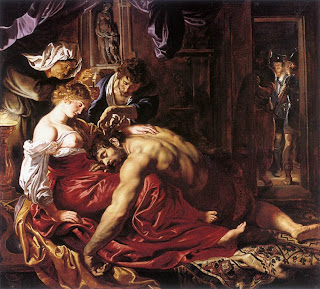
Peter Paul Rubens - Samson and Delilah, National Gallery, London
Naming just a few is sufficient to see that ancient man saw in hair the same iconography as it has today.
In our own more recent and extant culture, a slightly comic example of this relationship is the visual link from big power to big wigs: literally, the Restoration wig, which persist today in the court-room.

The more powerful and senior you are, the bigger your wig, culminating in the huge wigs of high-court judges. In a 1992 consultation it was decided to retain the wig, as “it imbues in laypersons a sense of the solemnity and dignity of the law.” Big, fake hair then is the necessary bastion of authority, a placeholder of dignity, in the British legal system.


but anyone who has been in ex-Soviet or east European nations during election-time cannot help but be in awe of the sheer hirsuteness of the candidates, their great Nietzschean moustaches signs of wisdom and reliability.

It may be very true that Berlusconi would not have been repeatedly re-elected had he allowed himself to go bald. If so, this could be seen as an embarrassing example of Italian voter ignorance, but also a soaring affirmation of the continuing power of big hair.
In psychoanalytic terms, men compete, in all walks of life, at all times, over the size of their phalluses. Men show off their phalluses in many ways, and many show it off on their heads too. It is both amusing and hard to avoid this equivalence when we look at people like Berlusconi, Peter Stringfellow, Fabio. Hair is a symbol of virility, sexual potency, youth. Their hair is a shiny, well-groomed and shoulder-length phallus.

Stringfellow: well-groomed, shoulder-length phallus
There is also a peculiar inverse of this: the skinhead, who seems to be boasting of his strength, in spite of having shorn himself. The skinhead is so strong in himself that he can rebel against the supremacy of the power of hair, drawing instead from his raw physicality. He shows his power by transcending the location of power in the hair. He, qua his body, is stronger than his hair. Perhaps we can say he has shaved off the phallus which hair represents, revealing that the phallus is his head itself.
In a very literal sense, knowledge is power, and notoriously to the criminal classes, all you need to know about someone can be found in a single strand of hair. While our complete DNA is to be found in almost every human cell, practically and forensically speaking, it is a person’s hair which most often is used to fix his identity. We could say that while our superficial fingerprints are on out fingertips, our real genetic fingerprint is most commonly accessed through our hair.
At the risk of seeming obsessed, lets stay with the iconography of the headscarf. We talked above about the taboo of concealing and revealing hair, and how this taboo is born from a strong desire for the thing which is concealed. So a headscarf, by definition, covers something exciting and desirable – this is in fact its stated purpose. I have written elsewhere about Foucault’s essay “We, Other Victorians”, in which he extends Freud in Totem and Taboo to question the motivation of creating such an obvious discourse (a pointer) to something we are pretending to hide. People conceal sexy things: breasts, ankles, and also long, dark, middle-Eastern locks, because they are so attractive they threaten to unshackle our inhibitions and cause civic unrest. For the security of our own society we cover up these sexual icons: they are withheld and rationed. Yet in covering them up we underline their powerful sexuality by emphasising them through the very fact of their proscription. We treat them as special hidden secrets, in a perverted attempt to rob them of their special sexual force. Furthermore, we explicitly grant the tabooed object the characteristic of being a locus of sexual attraction. In reality, the sexual attraction of a person is to be found in them as a whole; but by isolating and censoring one element – their breasts, or their hair – we are annexing that overall power into one place, which is then prohibited and tabooed. All physical censorship is synecdoche, in which the tabooed body-part stands for the sexuality of the whole person.
So the link to power? Well, having focused sexual power in one place, for example, in a Muslim woman’s hair, who then holds the key to all this power? Who can withhold or grant access to this illicit store of sexual energy? It is the woman herself who wears the headscarf. So in being the keeper of this strong desire, those women who wear headscarves hold under wraps a great deal of sexual power: the suggestive sexual power of the unseen, the withheld, the imagined, the unobtainable. In revealing her hair, that woman unleashes a sexual potency so strong it had needed to be contained. This fact is also seen through its converse: it is well known that wearing revealing clothes often has the opposite effect to the one intended: revealing too much is less sexy than leaving something to the imagination. Hence the tease is sexier than the strip. Anyone who has been given the privilege of seeing the hair of a woman who normally always wears a headscarf will have experienced first-hand the extraordinary power held by the unveiling of acres of wavy, shiny, black hair. In most respects these Islamic woman are by Western standards oppressed, or even brainwashed, but in this limited but important context they hold all the cards. Their enforced modesty (not just in hair, but in manners, abstention, shyness and so on) gives them a great power: the power to withhold and release sexual potential at will.
Moving on to more conventional and well-proven relationships between power and hair, one can look at innumerable mythical stories: Samson, whose trim by Delilah betrayed him and stripped him of his power;

Peter Paul Rubens - Samson and Delilah, National Gallery, London
Medusa, favourite of psychoanalysts, whose ophidian locks themselves turn people to stone;
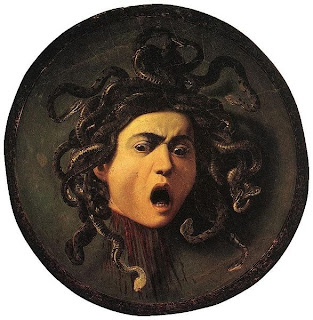
Caravaggio - Medusa, Ufizzi, Florence

Caravaggio - Medusa, Ufizzi, Florence
Nisos, protected by a magic lock of purple hair; Pterelaos, whose immortality, dependent on a gift of hair from Poseidon, is reminiscent of the cult of the reliquary (discussed in the next post, on hair, magic and superstition); and Apollo (also called chrysokomon – meaning with golden hair):
God of the golden bow,
     And of the golden lyre,
And of the golden hair,
     And of the golden fire,
Keats, Hymn to Apollo, 1815
Naming just a few is sufficient to see that ancient man saw in hair the same iconography as it has today.
In our own more recent and extant culture, a slightly comic example of this relationship is the visual link from big power to big wigs: literally, the Restoration wig, which persist today in the court-room.


Politically, Berlusconi and his hair transplant may look like a typically buffoonish act,


In psychoanalytic terms, men compete, in all walks of life, at all times, over the size of their phalluses. Men show off their phalluses in many ways, and many show it off on their heads too. It is both amusing and hard to avoid this equivalence when we look at people like Berlusconi, Peter Stringfellow, Fabio. Hair is a symbol of virility, sexual potency, youth. Their hair is a shiny, well-groomed and shoulder-length phallus.

Stringfellow: well-groomed, shoulder-length phallus
In a very literal sense, knowledge is power, and notoriously to the criminal classes, all you need to know about someone can be found in a single strand of hair. While our complete DNA is to be found in almost every human cell, practically and forensically speaking, it is a person’s hair which most often is used to fix his identity. We could say that while our superficial fingerprints are on out fingertips, our real genetic fingerprint is most commonly accessed through our hair.
Subscribe to:
Posts (Atom)

 Posts
Posts


