Tuesday, 16 February 2010
San Lorenzo, A Story


Corpus Domini, A Story
With this unvoiced feeling lurking within me, in small Tuscan and Perugian towns not in the hills but on the fertile plains, towns suffused with knowing workadayness, I would await the change of trains by going in search of an internet café in order to do nothing but sit for a moment to check my inbox, as an injured man might pummel his own wounds as if he were convinced his body had a limited supply of pain which could be exhausted through a dedicated course of self-infliction, or as an addict might attempt to cure himself through blindly consuming his vice into oblivion.
In one such town, in a state of headiness from the dusty alien light and in a state of ritualised anxiety, I left the station and walked across the municipal square, towards the centre, following the age of the architecture backwards into the past. I came after a little while to the main church, out of which a procession was flowing like a human mudslide. This, I discovered, was the Sunday after Corpus Domini, and the devout came out of the cool darkness of the church brightly-coloured and unhesitatingly, reminding me unavoidably of colourful handkerchiefs pulled endlessly from a magician’s nose. Since the majority of the town’s adults seemed to be emerging from the church, the thin layer of onlookers must have been none but the wives and children of the participants. I watched in the shade of a triumphal pillar. After a while I found myself pulled in the wake of the marchers by their collective momentum. I was inclined to move with a marching band that emerged out of the church portal into the afternoon light, wishing, as I had once played in one, to examine the subtle differences which demarcate shared pursuits: the cadence of their footfall, the tightness of their turning steps, the presence or absence of little music stands welded onto their instruments, the colours of their straps, socks and gloves, the age and carriage of the players: their commitment or disinterest. So dragging my luggage behind me, an encumbered procession of one, I continued awkwardly alongside, tripping up and down the high pavement edges, with my wheeled bag clipping ungracefully lampposts and ungraciously the heels of onlookers, quite out of time to the music, the bombastic Fascist brass writing that seemed oddly not to have been wiped out in Italy as it had been in Germany since the war. Seeing a few blocks down that the marchers were looping around the town, and becoming fed up with the cumbersome bag I was dragging through the narrow crowd, I decided to cut down a sidestreet and rejoin the processioners nearer the station square. Seeing on this deserted road an internet sign, I ducked in, sensing the certainty of another crushing rebuff rising up in my gut.
The white-tiled floor was filthy, unforgiving strip lighting bathed a scatter of plastic garden chairs in a fuzzy institutional light, the chairs clustered into clumps rather than aligned with terminals, as if placed in order to be obstacles to a convenient entry or a hasty escape. The sound of the plastic legs being pushed around was heavy with moisture, perspiration seeping off the two-dozen or so Chinese teenagers, off their foreheads or through patches of their unbranded cotton tshirts, grey-lit by screens, standing around, or seated or betting at some game of cards, arguing. As I walked in those not involved in the card game looked up with contempt, those at their computer games remained in utter stillness, all controlling a figure, their lifesake, who runs endlessly on the spot as his landscape moves under him, a planet rolling round and round and from side to side, forever curving away beneath, the exact inverse of a mouse in a treadmill. The sweat-bright yet somehow poorly lit room, tiles grimy, accumulations of foot-swept dust and hair at each desk and in each corner, felt like some weirdly upgraded voluntary workhouse, and brought a sense that someone had flicked some switch in reality, as if the train that carries us on through life had been suddenly diverted to the wrong track by a group of delinquent teenagers throwing down the point. I sat at a screen. Everything was in Chinese. I could recognise all the symbols but I was unable to make anything work, as if the computer itself was some parochial bureaucrat pretending to speak only Chinese, innocently and stubbornly refusing to comply with my requests. I got up flustered and overheating, and left quickly without paying, knocking aside and dragging my bag waist-deep in the plastic garden chairs, giving a undefined gesture to the staring adolescents, signifying nothing but confusion and the acknowledgement that I had wandered into a place I didn’t belong.
Outside the pale orange dusty light of Tuscany hovered just above the stench of incense and the stench of patriotic music which housed the otherness of Catholicism, as the parade marched perpendicular across the end of the road. As I stepped from out of the room and in to the street, the contrast of these two evident realities was so great that I seemed to have made some deeper transition, as if stepping out of the inside of one person’s imagination into the imagination of another, as if these two tableaux were nothing but furnished rooms in the memories of people whose lives I would never hope to know or understand. I stood feeling a little high, a little dissolved, in this desert watching the shifting dune of the devout blowing down the street as if carried on by the winds of the certainty of salvation. It seemed to me on the other hand that the notion of certainty itself was an act of faith, and that I might dissolve into the fissure between the two opposing realties either side of me, realities of such incongruence as to defy the very possibility of a single self that could encounter both. Seeking to escape back into my own reality I headed directly to the train station to await my connection to Rome.
Saturday, 29 August 2009
The Tomb of Shelley

Shelley had originally planned to have himself buried in the old part of the Non-Catholic cemetery in Rome, near to his infant son. The story goes that in Shelley’s presence the supposed site of his son’s body was dug up so as to ensure its location. Instead of the body of an infant, the body of a grown man was found. Shelley, who must have been distraught at the implications of the absence of the boy’s body, was therefore forced to abandon the wish to be buried with his son, and had to settle for an approximation. In 1822, a year after Keats’ death, Shelley too joined him under the shadow of the Cestius pyramid. After only a few weeks there, “Byron’s Jackal”: Romantic hanger-on, groupie and all-purpose wild man Edward Trelawney exhumed Shelley’s ashes and had them reburied in another part of the cemetery, buying up the adjacent plot for himself, where he himself was buried nearly 60 years later. Trelawney seems unable to have kept his hands off Shelley’s remains: he had, during Shelley’s cremation on a Tuscan shore, reached into the pyre and plucked Shelley’s heart from the decomposed and flaming carcass.

The tomb of Shelley had recently been given an artless “makeover”, one of the cemetery’s proud expat volunteers told me. The “ugly old ivy” had been ripped up, and the whole thing surrounded by bark chips, like a children’s playground. A small ornamental maple (I would've called it an acer) had been planted on his grave. She had no idea why they had chosen a maple to plant on Shelley’s grave.


Monday, 24 August 2009
The Spectre of Reality: The Non-Catholic Cemetery, Rome


It is also a cemetery of eclectic peoples, beliefs and symbolisms. Keats is buried in one corner, and Shelley too. Gramsci, father of Italian communism, Marxist atheist and closet Christian, is interred near the ossuary, his grave garlanded with red flowers and red ribbons. Many of the gravestones are truncated or collapsed columns, indicating the grave of a child or young person. Amongst the gravestones can be found several Stars of David, including the Fischer brothers, buried beneath the same stone: one Christian, one Jewish. Orthodox and Lutherans, Cyrillic, German, Greek, Estonian and countless other languages and denominations lie side by side, interlaced in a unified non-Catholic firmament.

The shared stone of the Fischer brothers, with cross and star

The tombs of children and the young, symbolized by half-finished columns

A grave reading only: "Mother"
In spite of endless solicitations for donations and claims of being on the brink of collapse, it is easily the most industriously maintained cemetery I have ever seen. It took a while to realise, washed over as I had been by the graves of the poets and the scent of the pines that, staffed by tireless and ruthless volunteers, this cemetery is a deeply restless and intrusive place.
As I walked around, perfectly intact graves were being scrubbed, renovated, and even dug up; plants and trees were being uprooted and re-planted; lengths of hose, wooden planks and electric drills could be seen and heard. I was told that a large grant had been squeezed out of the German Embassy for the continued upkeep of the ‘German grave’, which was being brutally power-hosed and re-carved, and that the Cemetery committee was now pushing the Russian Embassy for cash to renovate their national memorial. So much for resting in peace.

Remains being exhumed
Perhaps the most ruthless example of this hard-headed intervention in the cemetery’s fabric is the inexorable exhumation of the remains whose families have not kept up with the required payments. On burial, a family can choose to buy the plot in perpetuity, or to buy a 30-year lease after which time their family will be asked to extend or the bones will be moved to the ossuary and the plot made available to the next customer. The cemetery committee wait, like parking wardens, for your time to expire. The volunteer relayed to me, utterly neutrally, how a young woman had come seeking her grandfather’s grave. She had seen a photo from the 1940s in which her father was standing by his father’s tomb. The young woman was told she was too late: the body had been dug up, the tombstone gone, his bones in the ossuary. The volunteer said they had either failed to contact anyone in the family or whoever they did find wasn’t interested. Little consolation to the man’s grand-daughter, who had made the personal pilgrimage to Rome to find and remember him.
Only a few years ago my family discovered that my great-great-grandmother, someone about whom we knew little, was buried in the Ancient Jewish Cemetery on the Lido in Venice in 1913. We were eventually able to find the grave, collapsed and overgrown, forgotten for nearly a century. Visiting, discovering her, was a privilege. We went on, as a family, to remove the ivy, have the collapsed columns and split flagstone fixed, and have new ironwork wrought. I know that at least materially it, she, will last till well after me and my children have forgotten it. No such privilege would be afforded us in the Non-Catholic Cemetery in Rome. As I walked around I came across two graves currently being dug up. I felt deeply sorry for those descendents who would come to seek their family in glorious and romantic Rome, the eternal city, and search in vain, finding corporeal reality in the place of sacred history.


Before and after: the tomb of my great-great-grandmother at the Jewish Cemetery on the Lido, Venice. On the left, as we found it, nearly destroyed; one the right, nearly finished. Not improved, but repaired.
As if perpetual interference in the repose of the dead were not enough, here the living must suffer it also. The sound of Rodrigo’s guitar concerto was wafting over the fragrant pine air. What was going on? What were those blocks hung on the walls of the cemetery? Not speakers? And then: “Ladies and Gentleman, the cemetery will close in 15 minutes, please make your way to the exit…”. Does the willful intrusion upon the peace of this cemetery never end? After five minutes of Rodrigo the guitar faded into a midi Air on a G-String. Over the next 15 minutes the announcement repeated multi-lingually until the we were informed that “the cemetery is about to close…”, and the large and expensive-looking electric iron gate, beeping and flashing like a reversing lorry, started to shut. It felt like some faceless public space: an airport or supermarket, where the presence of the individual is deliberately negated. We, mourners or pilgrims, were being treated like interlopers whose presence was resented but unfortunately necessary, herded around as if the intricate and personal symbology of making memorials were some material process like shopping or checking-in. Imagine if such invasiveness reared up during a moment of profound private contemplation. In spite of all the glamour of being buried in Rome, I would hate to be here.
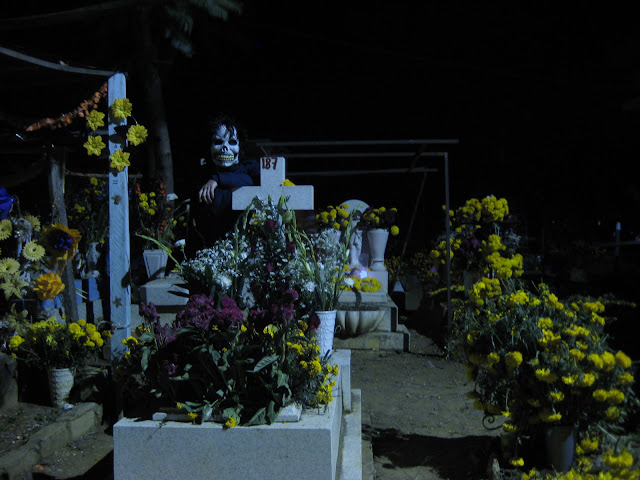
Unfortunately, maintaining or repairing something is not synonymous, as the cemetery’s current crop of meddlers seem to think, with improving it. To maintain a grave is to stop it being destroyed by time; but to improve a grave, on the other hand, is a concept bordering on the oxymoronic. You can’t improve the grieving or memorial process. A cemetery should be a place of rest and calm, not one of change and improvement. Improving is not interchangeable with planning for the future: these improvements serve only to violently introduce the terrestrial present to a place where this reality should be excluded. Cemeteries are for us to remember the dead, to reflect upon them and upon us. They could be grand like Verano, wild like Highgate, intense and historic like Tikhvin, alive like Oaxaca, but they must allow in some way the dead to rest and the living to engage with them. To do this they should nurture a sense of timelessness, allow the past to continue to be somehow just also present, where the gossamer membrane between the bereaved and the deceased is momentarily dissolved. A cemetery should somehow act as a metaphorical rope-bridge which momentarily and temporarily allows us to cross over to the other side, be present there, and return to reality. In this resting space a psycho-spatial fissure opens in which the living can make communion with the dead. It must allow us to develop inside of us a place where we can locate our memories and feelings for those we have come to see, letting the spectre of reality loosen for the visit.
It seemed to be really fundamentally getting death wrong to treat a cemetery as a kind of pet project for a group of bored expats, an extended ornamental garden onto which to project merely contemporary tastes onto what should be a lacuna beyond time. Being deep-cleaned, power hosed, renovated, replanted and modernized drags the cemetery out of the timeless sacred and into the mundanity of the present. The despoilment of Shelley’s tomb is a gross example. The spectre of reality has infringed on the actuality of non-existence. The dead are beyond our human need to update and re-enliven. To re-introduce the real world into this place where living reality must be suspended is to deny the dead their identities, and in so doing, deny the role of mourner or pilgrim too. For who is a mourner if the deceased is stripped of the existential properties of restful death? This cemetery’s future is not secured by its zealous upkeep, but endangered.
Tuesday, 18 August 2009
The Tomb of Keats
Here lies one whose name was writ in water.


Keats’ grave doesn’t record his name, which is only revealed on Severn’s grave adjacent. On Keats’ tombstone is engraved a lyre only half-strung; his poetic voice perpetually incomplete. The dedication is to "A young English poet". Below, the epitaph reads “Here lies one whose name was writ in water”. This monumentally touching grave is a colossal act of self-denial. Its power comes from here, from Keats' knowing subsumption from the individual to the undivided. In death we can no longer hide the subtle communion we are always taking with the world, a communion Keats in life had the art to describe. Unfortunately not everyone can appreciate that great power can come from great subtlety, and Keats’ subdued relinquishment of selfhood does not pass without comment. Nearby can be found a Victorian acrostic attempting to redress the ingloriousness of Keats’ epitaph through a kind of hyper-Keatsian overdone romanticism: “…if thy name be writ in water, each drop has fallen from a mourner’s cheek…” and so on. Keats follows introspection to the point of vanishing into the totality of life, beauty and reflection from which he had hardly felt separated. He was not afraid of this self-knowing doom and did not see it as a weakness that needed bolstering. Unfortunately the commissioner or author of this doggerel could not let Keats' silence be the last word. In case the visiting pilgrim was in any doubt, we are informed that Keats is “Not honoured less for Epitaph so meek!” Not everything that it true needs to be said.

Monday, 3 August 2009
Nude vs Prude in the Vatican Museums

 On the left, a 2nd century BC bronze Hercules in the Capitoline Museum in Rome, dressing to the left. On the right, a similar Hercules in the Vatican Museums, chastened.
Around half of the Roman and Hellenic nude statues in the Musei Vaticani have had their genitals crudely covered by fig leaves. These peculiar blotches are visually incoherent. They interrupt the continuity of nude musculature and rather undermine the effect of the nude as a representation of human beauty. They are also conceptually weird, floating, glued or perhaps stapled on. They lack the symbolism imbued by the artist to each other object in the production of allegorical art.
As with all censorship, in the end it is the censor who exposes himself. There’s nothing funnier than an enraged prude, and above all these sheaths show to comic effect the self-defeating nature of censorship, in this case intended to sustain the decency of the Papacy. They have surrounded themselves with cocks and fannies, eye-catchingly prominent by their conspicuous absence. In fairness, many have been uncovered, but only in the sculptures which are deemed to have particular artistic value.
On the left, a 2nd century BC bronze Hercules in the Capitoline Museum in Rome, dressing to the left. On the right, a similar Hercules in the Vatican Museums, chastened.
Around half of the Roman and Hellenic nude statues in the Musei Vaticani have had their genitals crudely covered by fig leaves. These peculiar blotches are visually incoherent. They interrupt the continuity of nude musculature and rather undermine the effect of the nude as a representation of human beauty. They are also conceptually weird, floating, glued or perhaps stapled on. They lack the symbolism imbued by the artist to each other object in the production of allegorical art.
As with all censorship, in the end it is the censor who exposes himself. There’s nothing funnier than an enraged prude, and above all these sheaths show to comic effect the self-defeating nature of censorship, in this case intended to sustain the decency of the Papacy. They have surrounded themselves with cocks and fannies, eye-catchingly prominent by their conspicuous absence. In fairness, many have been uncovered, but only in the sculptures which are deemed to have particular artistic value.
The Victorians are just as guilty or this inverted perversity. Unfortunately for the majority world, while Victorian values cling on only in a few outposts (by-passed rural islands, public schools) the Vatican continues to dictate half the planet’s policy on sexual health and gender issues. From a theological perspective, this prudishness serves to place men firmly outside the garden, into a place of sin and shame. The Ancients, the creators of these works of art, had lived in paradise, before Adam was cast out, before God hated men. These Ancients were not ashamed of themselves, living with philosophy, culture, debate, democracy, tragedy, games, as well as nudity and occasional sexual freedom. The Papacy, graphically and literally, imposed shame upon them, defrocked them of innocence and beauty, and dragged them into God’s new fig-fringed repression. The natural state of man, they claim, is not a Greek ideal: the hero, the youth, the philosopher or athlete, but the sinner and the guilty. Having enforced on men self-embarrassment, this doctrine can then monopolise self-worth through confession, indulgence and absolution. Thus the same cause spreads the illness and then sells the cure, like an itinerant quack with the lurgy.
Monday, 27 July 2009
Cimitero del Verano, Rome, a true necropolis


 A boulevard of the Verano Cemetery
Wednesday, 1 July 2009
The Pantheon

The Pantheon in Rome is shockingly old. The marbled floor is on a noticable camber from centre to rim, no doubt the great walls, which conceal the buttresses and arches required to hold up the dome, are sinking into the ground of the Piazza della Rotunda like a biscuit mould cutting through pastry. In typically solid Roman proportional architecture, the dome is as high as it is wide, given the peculiar sensation of being inside a circular cube. Above is a great occulus, a skylight through which a pole of light traces a parabola around the floor. This occulus is the manifested absence of the Roman keystone. In a normal two dimensional arch, the keystone is the key stone, supporting through pressure on itself the weight of the building. The key stone is the physical and conceptual focus of the arch, the confluence of the building's weight. But when translated into three dimensions, the point can be transormed from thing to nothing. The defining presence of the keystone becomes its own absence. In the place where all the pressure of the mighty dome concentrates there is a hole, a void. A ring of keystones all press inwards on each other, focusing all the energy and weight of the mighty dome invisibly into nothing but air. It is a triumph of lack, an existential vertice, the imperceptible point of total connection, before the weight is conducted, spreading and dropping down through the solid walls.
 The occulus eyeing idlers in 1911.
Instead we gape and chat, photograph, step around, bump into each other, watch. This must be more like the forum, some ancient marketplace of exchange, debate, meeting. It is called a church but there is no sense of religion. People come who do not call themselves pilgrims. But they are pilgrims to their own experience in this miraculous primeval space. Instead of being reverential to some other being, a divine presence extant in holy places, the pilgrims are reverential to their own presence in the building. This is a secular existential pilgrimage. The presence of being there, inside these walls, in a space made possible by that the sublime building which encloses it. These walls make us flesh. We are not reverential of a divine presence, but of our own presence.

 Posts
Posts


