Showing posts with label Keats. Show all posts

Tuesday, 22 September 2009

Hair: Strength/Power

So we’ve seen the extent to which the loss or covering over of hair creates different kinds of shocks, punishments and taboos. Naturally the converse is also true: the ownership of great hair is a living allegory for the ownership of great power.

At the risk of seeming obsessed, lets stay with the iconography of the headscarf. We talked above about the taboo of concealing and revealing hair, and how this taboo is born from a strong desire for the thing which is concealed. So a headscarf, by definition, covers something exciting and desirable – this is in fact its stated purpose. I have written elsewhere about Foucault’s essay “We, Other Victorians”, in which he extends Freud in Totem and Taboo to question the motivation of creating such an obvious discourse (a pointer) to something we are pretending to hide. People conceal sexy things: breasts, ankles, and also long, dark, middle-Eastern locks, because they are so attractive they threaten to unshackle our inhibitions and cause civic unrest. For the security of our own society we cover up these sexual icons: they are withheld and rationed. Yet in covering them up we underline their powerful sexuality by emphasising them through the very fact of their proscription. We treat them as special hidden secrets, in a perverted attempt to rob them of their special sexual force. Furthermore, we explicitly grant the tabooed object the characteristic of being a locus of sexual attraction. In reality, the sexual attraction of a person is to be found in them as a whole; but by isolating and censoring one element – their breasts, or their hair – we are annexing that overall power into one place, which is then prohibited and tabooed. All physical censorship is synecdoche, in which the tabooed body-part stands for the sexuality of the whole person.

So the link to power? Well, having focused sexual power in one place, for example, in a Muslim woman’s hair, who then holds the key to all this power? Who can withhold or grant access to this illicit store of sexual energy? It is the woman herself who wears the headscarf. So in being the keeper of this strong desire, those women who wear headscarves hold under wraps a great deal of sexual power: the suggestive sexual power of the unseen, the withheld, the imagined, the unobtainable. In revealing her hair, that woman unleashes a sexual potency so strong it had needed to be contained. This fact is also seen through its converse: it is well known that wearing revealing clothes often has the opposite effect to the one intended: revealing too much is less sexy than leaving something to the imagination. Hence the tease is sexier than the strip. Anyone who has been given the privilege of seeing the hair of a woman who normally always wears a headscarf will have experienced first-hand the extraordinary power held by the unveiling of acres of wavy, shiny, black hair. In most respects these Islamic woman are by Western standards oppressed, or even brainwashed, but in this limited but important context they hold all the cards. Their enforced modesty (not just in hair, but in manners, abstention, shyness and so on) gives them a great power: the power to withhold and release sexual potential at will.

Moving on to more conventional and well-proven relationships between power and hair, one can look at innumerable mythical stories: Samson, whose trim by Delilah betrayed him and stripped him of his power;


Peter Paul Rubens - Samson and Delilah, National Gallery, London


Medusa, favourite of psychoanalysts, whose ophidian locks themselves turn people to stone;
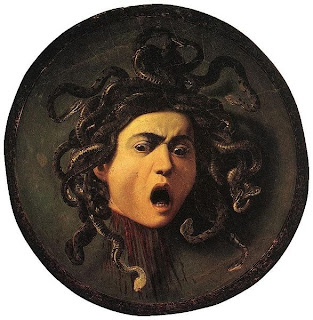

Caravaggio - Medusa, Ufizzi, Florence

Nisos, protected by a magic lock of purple hair; Pterelaos, whose immortality, dependent on a gift of hair from Poseidon, is reminiscent of the cult of the reliquary (discussed in the next post, on hair, magic and superstition); and Apollo (also called chrysokomon – meaning with golden hair):
God of the golden bow,
And of the golden lyre,
And of the golden hair,
And of the golden fire,

Keats, Hymn to Apollo, 1815

Naming just a few is sufficient to see that ancient man saw in hair the same iconography as it has today.

In our own more recent and extant culture, a slightly comic example of this relationship is the visual link from big power to big wigs: literally, the Restoration wig, which persist today in the court-room.

The more powerful and senior you are, the bigger your wig, culminating in the huge wigs of high-court judges. In a 1992 consultation it was decided to retain the wig, as “it imbues in laypersons a sense of the solemnity and dignity of the law.” Big, fake hair then is the necessary bastion of authority, a placeholder of dignity, in the British legal system.


Politically, Berlusconi and his hair transplant may look like a typically buffoonish act,

but anyone who has been in ex-Soviet or east European nations during election-time cannot help but be in awe of the sheer hirsuteness of the candidates, their great Nietzschean moustaches signs of wisdom and reliability.

It may be very true that Berlusconi would not have been repeatedly re-elected had he allowed himself to go bald. If so, this could be seen as an embarrassing example of Italian voter ignorance, but also a soaring affirmation of the continuing power of big hair.

In psychoanalytic terms, men compete, in all walks of life, at all times, over the size of their phalluses. Men show off their phalluses in many ways, and many show it off on their heads too. It is both amusing and hard to avoid this equivalence when we look at people like Berlusconi, Peter Stringfellow, Fabio. Hair is a symbol of virility, sexual potency, youth. Their hair is a shiny, well-groomed and shoulder-length phallus.

Stringfellow: well-groomed, shoulder-length phallus


There is also a peculiar inverse of this: the skinhead, who seems to be boasting of his strength, in spite of having shorn himself. The skinhead is so strong in himself that he can rebel against the supremacy of the power of hair, drawing instead from his raw physicality. He shows his power by transcending the location of power in the hair. He, qua his body, is stronger than his hair. Perhaps we can say he has shaved off the phallus which hair represents, revealing that the phallus is his head itself.

In a very literal sense, knowledge is power, and notoriously to the criminal classes, all you need to know about someone can be found in a single strand of hair. While our complete DNA is to be found in almost every human cell, practically and forensically speaking, it is a person’s hair which most often is used to fix his identity. We could say that while our superficial fingerprints are on out fingertips, our real genetic fingerprint is most commonly accessed through our hair.

Tuesday, 18 August 2009

The Tomb of Keats


Here lies one whose name was writ in water.

The tomb of Keats lies in a corner of the old part of the cemetery in the shadow of the steep, flat Roman pyramid. The stone was organised by Keats’ friend Joseph Severn, who is buried next to him. Severn died aged 85, 58 years after Keats’ death at 25.


It is truly an idyllic spot, and the surrealism of the rich grey pyramid evokes further the scene of some ruined elysium conceived in the mind of Piranesi.


Indeed, Severn wrote in a letter that he came to visit Keats only to find a shepherd asleep, “his head resting against the gravestone, his dog and flock of sheep about him, with the full moon rising beyond the Pyramid of Caius Cestius. One long moonbeam stole past the Pyramid and illumined the outline of the young shepherd’s face.”


Keats’ grave doesn’t record his name, which is only revealed on Severn’s grave adjacent. On Keats’ tombstone is engraved a lyre only half-strung; his poetic voice perpetually incomplete. The dedication is to "A young English poet". Below, the epitaph reads “Here lies one whose name was writ in water”. This monumentally touching grave is a colossal act of self-denial. Its power comes from here, from Keats' knowing subsumption from the individual to the undivided. In death we can no longer hide the subtle communion we are always taking with the world, a communion Keats in life had the art to describe. Unfortunately not everyone can appreciate that great power can come from great subtlety, and Keats’ subdued relinquishment of selfhood does not pass without comment. Nearby can be found a Victorian acrostic attempting to redress the ingloriousness of Keats’ epitaph through a kind of hyper-Keatsian overdone romanticism: “…if thy name be writ in water, each drop has fallen from a mourner’s cheek…” and so on. Keats follows introspection to the point of vanishing into the totality of life, beauty and reflection from which he had hardly felt separated. He was not afraid of this self-knowing doom and did not see it as a weakness that needed bolstering. Unfortunately the commissioner or author of this doggerel could not let Keats' silence be the last word. In case the visiting pilgrim was in any doubt, we are informed that Keats is “Not honoured less for Epitaph so meek!” Not everything that it true needs to be said.


Saturday, 1 August 2009

A post-Freudian overview of culture, from the Renaissance to the 20th Century

Artistically the Renaissance was the rediscovery of a classical ideal: the reintroduction of beauty, through art and form, as an end in itself. The modern world developed in homage to the ancient world, exhuming a new spiritual depth, a new humanism. This development of the individual, a global coming-of-age, and its ensuing expansion of refinement and sophistication, cannot be said to have widely occurred before the 14th century. Philosophically, the Renaissance is driven by a new translation of a complete set of the works of Plato, by Ficino in Florence in the middle of the 15th century. Until then, throughout the Christian Dark Ages, Aristotle had taken up practically the entire horizon of Western philosophy (then really theology). With the dissemination of Plato, the scholasticism of Aristotle was supplemented by the pantheism and spirituality of Plato. This appealed to the renaissance Italians as they sought to rediscover pagan Roman and Classical ideals, which in turn would ignite the development of the Uomo Universale and the new individuality. Such was Plato’s resurgent influence that already by 1511 Raphael considered him to be Aristotle’s equal and his counterpoise, painting the two of them as the twin axes of Western thought in The School of Athens. A few rooms away, Michaelangelo’s re-imagining of a much wider developmental theme is being born on the ceiling of the Sistene Chapel.

The School of Athens by Raphael, in the Vatican. In the centre Aristotle, in blue, gestures in benediction to the ground. On his right Plato points towards the heavens. Raphael is symbolically contrasting their respective subjects of inquiry.

After this new dawn of subjectivity came the need to quantify what had been uncovered. Once self-consciousness had developed around the sophistication of individuality, it needed to be understood. This is the rebirth of the objective. The Enlightenment was the rigourisation of this process: the development of the possibility of objectivity. Descartes is the philosophical justification, the theoretical underpinning of this process. Descartes finds the creative humanistic impulses of the Renaissance (and the Classical world) insufficient foundations for the truth he sought, and in The Meditations of 1641 locates these truths in a new space: the thinking mind. Here begins the disconnection of humanity from its shadow self, which had driven our culture, in the Greek tragedies, Shakespeare and the Renaissance artists. This disconnection still shackles us today. Not until Sartre is it realised that the terminal error in “I think therefore I am”, is that his “I” is just only the thinking “I”: the “I” who thinks is not the same as the “I” who is.

The Enlightenment, starting with the ruthless Cartesian pursuit of first principles harking back to Socrates, reached adulthood with the applied logic of the Empiricists. This pursuit of knowledge and its appropriation by an educated elite saw its physical manifestation in the founding of the academies of London and Paris. This was in turn challenged by the social and cultural inversions undertaken during the French Revolution. From the late 18th century a new tendency grows away from objectivity, back to the human, towards the irrational and the subjective. This movement is called Romanticism. Between the French Revolution in 1789 and the ascension of Queen Victoria in 1839, Europe sees the centre of gravity of genius shift from political philosophers and rationalists of the Enlightenment like Samuel Johnson, Gotthold Lessing, Hume, Smith, Hobbes, Locke, Franklin and Jefferson, to a new kind of revolutionary humanist. Socially, this period saw the Great Reform Bill, the Utopian vision of Fourier and the life of Mary Wollstonecraft. Kant, and later Hegel and Schopenhauer, give birth to Idealism, introducing the transcendental in addition to the phenomenal, and placing contradiction, not rationality, at the heart of philosophy. Now the Artist was rebel, pioneer and psychologist - Goethe, Beethoven, the Brontës, Blake, Turner and Byron. These Romantics sought to blast through the empiricist petrification of truth into mere knowledge, and to instead reclaim the Classical and Renaissance ideal that instead:

Beauty is truth, truth beauty,—that is all
Ye know on earth, and all ye need to know.

Keats, Ode on a Grecian Urn, 1819

As the wheel turns these ideals too get overtaken. The zeitgeist shifts back, thanks in the main to the Victorians, to a new industrialisation, Empire, construction and vigour. In 1839 the invention of the Daguerreotype spells the elimination of artistic realism. Mass production crushes the relationship of the consumer to the artisan, isolating both. The age of steel was emerging from the age of stone.

In wide perspective, we have two repeating poles: the rationalism of the Enlightenment and the materialism of the Industrial Revolution, and the humanism of the Renaissance and the irrationality of Romanticism. Finally, at the start of the Twentieth century, Freud is able to reveal these poles as the flints whose sparks charge the dynamo of the human experience. By internalising the irrational, psychoanalytic theory makes sense of these opposites. The irrational (or individual) and the rational (or social) are different evidence of the same phenomenon. They are translations. The move from Renaissance to Enlightenment to Romanticism to Industrialisation can be internalised: the human contains within him the irrational, which, in order to become rational, projects onto the material. These internal states occur historically only in virtue of being projected from Self onto Other. It is towards the reunification of this dichotomy of the human self: from mutually exclusive states occurring consequently to complementary states occurring simultaneously, that we now evolve.