Friday, 14 August 2009

The Phallus and the Womb

Men create not because of the presence of the phallus,
but from the absence of the womb.


The human phenomenon that psychologists seek to explain is something like: Why do we behave how we behave? Why, for us alone, does doing seem to be so much more important than being? Why do we create, why do we strive, why do we compete, why do we destroy? What’s really going on?

Freudian psychoanalysis has a clear reason. The root is the phallus.

From birth the phallus, or lack of phallus, obsesses and possesses us. If we have one we are frightened we will be, first literally, and later metaphorically, castrated. If we don’t have one, we are covetous of the father’s phallus, and later give birth in order to produce a male heir and therefore possess this phallus. So powerful is the phallus, that women want to reproduce in order to get their hands on one.

In adulthood, this phallus continues to grip us (rather than the other way round) with its subversive demands. It pervades our desires and our actions. So suffuse is its power, according to psychoanalysts, that in an effort to maintain this Theory of Everything, they may tie themselves up in strange concepts and images like: “the woman has taken the phallus”, and “if you speak you may be castrated”. Most clients find such interpretations at best reductive, undermining the complexity of their experiences; and this jargon, these ex cathedra explanations, patronising. At worst it is incomprehensible or offensive. Some clients may find these interpretations powerful perhaps more from the graphic imagery than from any deep instinctive resonance with personal experience.

But if there is some element of physical sublimation, perhaps it is not the phallus, but the womb, wherein our fear is born.

A fact is that women give birth, men cannot. A woman (although not all choose to), can know that they have a purpose utterly fundamental for everything to exist. Reproduction is the definition of life, and women manifest it. Men can never experience the miracle of childbirth. It is this colossal inadequacy which triggers all the activity of men.

Why does culture exist, why do we create art: why was most of it done by men? Because men don’t give birth.
Why do we seek answers, why do we hunger for scientific progress: why are most scientists men? Because men don’t give birth.
Why do we cluster together into social groups, compete, build, organize, create laws, and rule: why are most rulers, philosophers and architects men? Because men don’t give birth.

Our fear is not of losing the phallus, it is an existential fear of death without reproduction (more on the existential connection to the womb forthcoming). This fear is not exclusively male, but it is men whose proximity to reproduction is not quite tangible. Having sex is not solely reproductive, and men are conditioned to want it without twinkles in their eyes. Pregnancy and birth are not normally present concerns to men. The whole process of insemination and childbirth is kept, as it were, at arm’s length from men. Women on the other hand are reminded monthly of their ability to conceive and of their virility.

So the fear of being sexually or phallically inadequate is in fact an existential fear about death and meaninglessness. Hence “castration anxiety” is in fact “sterility anxiety”. “Phallic competition” is in fact “reproductive competition”. Half the race feel disconnected from the reproductive purpose of life. They know this, and they know they will die. This is why being is not enough, and they revert to doing.

Instead of children, men give birth to the things they create. It is in this that they must prove themselves. They seek to suppress their anxiety of not having a womb by reproducing endlessly in the material world. Men cannot rely on any inherent tangible meaning, qua men. They have no qualities. So every activity becomes a need to prove one's worth. Life is a debt. Women can pay it off by giving birth. Men must pay it off by earning their value, proving their worth. This is the competition between men. It’s not the size of the phallus, it’s the size of the offspring.

To extend Freudian concepts, girls do not want to sleep with their fathers because they covet his phallus, but because they can reproduce with him. They are themselves evidence for his reproductive powers. Girls compete with their mothers not for the father’s phallus, but for his sperm. Boys do not want to sleep with their mothers and kill their fathers because of phallic envy, but because this would be the fastest and most obvious way to reproduce. “She had a baby for him (I am it), and now I overcome him and she will have a baby for me.” The notion of competitive dad is not about the fear of the son castrating the father, but that the son is virile and the father sterile.

How did Freud miss this incredibly obvious fact that women alone give birth, and attribute as the crux of his theory to the phallus and not the womb? Perhaps mostly we can attribute this massive oversight to his culture. All around him (and us) stand the works of men, the characteristics of men, great competing creations, artificial phalluses. Women were so rarely thought of that perhaps he simply overlooked them. So complete is man’s sublimation of his reproductive inadequacies that his creations and powers at the time of Freud (and all before him), had undermined the importance of women until they had no powers and little influence. As he looked about him, Freud saw the fruits of his gender’s loins. He saw sex manifesting as art and creation, death manifesting as destruction, and he saw it all happening at the hands of man. Of course therefore, it would be to a male characteristic that he would attribute all this. Men create, so it must be in man the cause of the creation. But it is not. Women, not men, hold in them the manifestation of the will to life.

Men create not because of the presence of the phallus, but from the absence of the womb.

Tuesday, 11 August 2009

Originality is Relative

Originality is relative, not absolute. Originality is a personal best, which is also necessarily a global event. To be original is to do something for the first time, not to be the first to do something for the first time. If we valued absolute originality as much as we think we do, we would not aspire towards known greats: to be compared to your heroes would be an accusation of plagiarism. We would be encouraged not to even have heroes.

A cliché does not become false through overuse. Each time we find in ourselves some new resonance, it is a true and genuine moment of personal discovery. Each awakening is original and important, irrespective of how many other people have had the same awakening before. Turns of phrase may be clichéd, but the content to which they point are original each time they become valid to each person.

Every baby is in absolute terms unoriginal, in relative terms unique. The birth and rebirth of cultural movements are the same. Cultural originality is also a gift which needs a mother. In absolute terms, Michelangelo was the least original of all artists. He stands on the shoulders of giants. He did not give birth to the new art of the Renaissance. The ancient artists gave birth to him.

Monday, 3 August 2009

Nude vs Prude in the Vatican Museums

On the left, a 2nd century BC bronze Hercules in the Capitoline Museum in Rome, dressing to the left. On the right, a similar Hercules in the Vatican Museums, chastened. Around half of the Roman and Hellenic nude statues in the Musei Vaticani have had their genitals crudely covered by fig leaves. These peculiar blotches are visually incoherent. They interrupt the continuity of nude musculature and rather undermine the effect of the nude as a representation of human beauty. They are also conceptually weird, floating, glued or perhaps stapled on. They lack the symbolism imbued by the artist to each other object in the production of allegorical art. As with all censorship, in the end it is the censor who exposes himself. There’s nothing funnier than an enraged prude, and above all these sheaths show to comic effect the self-defeating nature of censorship, in this case intended to sustain the decency of the Papacy. They have surrounded themselves with cocks and fannies, eye-catchingly prominent by their conspicuous absence. In fairness, many have been uncovered, but only in the sculptures which are deemed to have particular artistic value. 

The Victorians are just as guilty or this inverted perversity. Unfortunately for the majority world, while Victorian values cling on only in a few outposts (by-passed rural islands, public schools) the Vatican continues to dictate half the planet’s policy on sexual health and gender issues. From a theological perspective, this prudishness serves to place men firmly outside the garden, into a place of sin and shame. The Ancients, the creators of these works of art, had lived in paradise, before Adam was cast out, before God hated men. These Ancients were not ashamed of themselves, living with philosophy, culture, debate, democracy, tragedy, games, as well as nudity and occasional sexual freedom. The Papacy, graphically and literally, imposed shame upon them, defrocked them of innocence and beauty, and dragged them into God’s new fig-fringed repression. The natural state of man, they claim, is not a Greek ideal: the hero, the youth, the philosopher or athlete, but the sinner and the guilty. Having enforced on men self-embarrassment, this doctrine can then monopolise self-worth through confession, indulgence and absolution. Thus the same cause spreads the illness and then sells the cure, like an itinerant quack with the lurgy.

Saturday, 1 August 2009

A post-Freudian overview of culture, from the Renaissance to the 20th Century

Artistically the Renaissance was the rediscovery of a classical ideal: the reintroduction of beauty, through art and form, as an end in itself. The modern world developed in homage to the ancient world, exhuming a new spiritual depth, a new humanism. This development of the individual, a global coming-of-age, and its ensuing expansion of refinement and sophistication, cannot be said to have widely occurred before the 14th century. Philosophically, the Renaissance is driven by a new translation of a complete set of the works of Plato, by Ficino in Florence in the middle of the 15th century. Until then, throughout the Christian Dark Ages, Aristotle had taken up practically the entire horizon of Western philosophy (then really theology). With the dissemination of Plato, the scholasticism of Aristotle was supplemented by the pantheism and spirituality of Plato. This appealed to the renaissance Italians as they sought to rediscover pagan Roman and Classical ideals, which in turn would ignite the development of the Uomo Universale and the new individuality. Such was Plato’s resurgent influence that already by 1511 Raphael considered him to be Aristotle’s equal and his counterpoise, painting the two of them as the twin axes of Western thought in The School of Athens. A few rooms away, Michaelangelo’s re-imagining of a much wider developmental theme is being born on the ceiling of the Sistene Chapel.

The School of Athens by Raphael, in the Vatican. In the centre Aristotle, in blue, gestures in benediction to the ground. On his right Plato points towards the heavens. Raphael is symbolically contrasting their respective subjects of inquiry.

After this new dawn of subjectivity came the need to quantify what had been uncovered. Once self-consciousness had developed around the sophistication of individuality, it needed to be understood. This is the rebirth of the objective. The Enlightenment was the rigourisation of this process: the development of the possibility of objectivity. Descartes is the philosophical justification, the theoretical underpinning of this process. Descartes finds the creative humanistic impulses of the Renaissance (and the Classical world) insufficient foundations for the truth he sought, and in The Meditations of 1641 locates these truths in a new space: the thinking mind. Here begins the disconnection of humanity from its shadow self, which had driven our culture, in the Greek tragedies, Shakespeare and the Renaissance artists. This disconnection still shackles us today. Not until Sartre is it realised that the terminal error in “I think therefore I am”, is that his “I” is just only the thinking “I”: the “I” who thinks is not the same as the “I” who is.

The Enlightenment, starting with the ruthless Cartesian pursuit of first principles harking back to Socrates, reached adulthood with the applied logic of the Empiricists. This pursuit of knowledge and its appropriation by an educated elite saw its physical manifestation in the founding of the academies of London and Paris. This was in turn challenged by the social and cultural inversions undertaken during the French Revolution. From the late 18th century a new tendency grows away from objectivity, back to the human, towards the irrational and the subjective. This movement is called Romanticism. Between the French Revolution in 1789 and the ascension of Queen Victoria in 1839, Europe sees the centre of gravity of genius shift from political philosophers and rationalists of the Enlightenment like Samuel Johnson, Gotthold Lessing, Hume, Smith, Hobbes, Locke, Franklin and Jefferson, to a new kind of revolutionary humanist. Socially, this period saw the Great Reform Bill, the Utopian vision of Fourier and the life of Mary Wollstonecraft. Kant, and later Hegel and Schopenhauer, give birth to Idealism, introducing the transcendental in addition to the phenomenal, and placing contradiction, not rationality, at the heart of philosophy. Now the Artist was rebel, pioneer and psychologist - Goethe, Beethoven, the Brontës, Blake, Turner and Byron. These Romantics sought to blast through the empiricist petrification of truth into mere knowledge, and to instead reclaim the Classical and Renaissance ideal that instead:

Beauty is truth, truth beauty,—that is all
Ye know on earth, and all ye need to know.

Keats, Ode on a Grecian Urn, 1819

As the wheel turns these ideals too get overtaken. The zeitgeist shifts back, thanks in the main to the Victorians, to a new industrialisation, Empire, construction and vigour. In 1839 the invention of the Daguerreotype spells the elimination of artistic realism. Mass production crushes the relationship of the consumer to the artisan, isolating both. The age of steel was emerging from the age of stone.

In wide perspective, we have two repeating poles: the rationalism of the Enlightenment and the materialism of the Industrial Revolution, and the humanism of the Renaissance and the irrationality of Romanticism. Finally, at the start of the Twentieth century, Freud is able to reveal these poles as the flints whose sparks charge the dynamo of the human experience. By internalising the irrational, psychoanalytic theory makes sense of these opposites. The irrational (or individual) and the rational (or social) are different evidence of the same phenomenon. They are translations. The move from Renaissance to Enlightenment to Romanticism to Industrialisation can be internalised: the human contains within him the irrational, which, in order to become rational, projects onto the material. These internal states occur historically only in virtue of being projected from Self onto Other. It is towards the reunification of this dichotomy of the human self: from mutually exclusive states occurring consequently to complementary states occurring simultaneously, that we now evolve.

Thursday, 30 July 2009

Oaxaca Cemetery, Memento Mori


The cemetery in Oaxaca, Mexico, carries this inscription above its tall wrought-iron gates:

Postraos: aquí la eternidad empieza, y es polvo aquí la mundanal grandeza

Bow down: here eternity begins, and here mundane greatness is dust.

For whom is this profound observation made? What does it tell us about the attitude towards death of the people who built this cemetery? It is certainly the exact opposite of the Cimitero del Verano in Rome. The Verano tries to beguile us by its claim that death is not sufficient for mortality: that as we live, we can also be dead.

In Oaxaca, in the wonderful Mexican unmorbid fascination with death, the cemetery is not a memorial of achievements in life, but a perpetual memento mori, a reminder of mortality. Montaigne suggested that we should live overlooking a cemetery and never forget that this was our universal destination, echoing Ecclesiastes: “do not all go to one place?” This too is the Oaxaqueñan affirmation. Nothing remains of our earthly glory, not here, but dust. The cemetery itself is the ultimate leveler, in which the same fate awaits all and everything. In a necropolis like Verano on the other hand, the cemetery is filled with the vanity of individual greatness, a greatness which tries to generate a social order it had had in life.

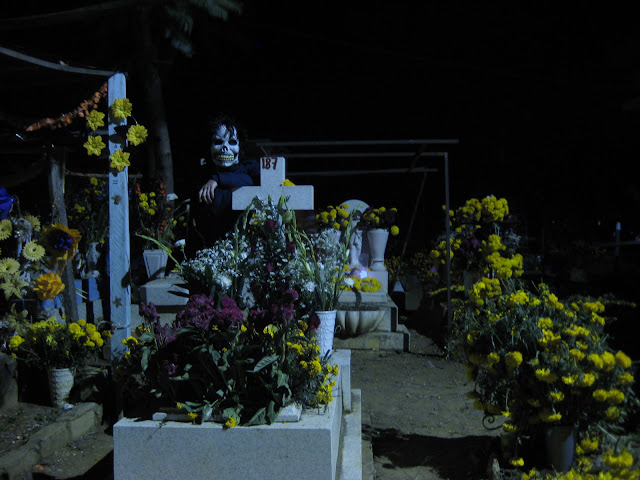
We visited Oaxaca during the Day of the Dead. One evening we asked the hotel receptionist where he was going that night, and he said “To the cemetery, to have dinner with my grandfather.” The cemeteries in Oaxaca, at around midnight, are a riot of noise and colour. In one corner groups of mariachi bands were playing, sometimes in competition. On the other side, cramped under a candle-lit catacomb-lined colonnade, a full orchestra and choir were sweating their way through the Mozart Requiem. Some people were dressed-up festively as skeletons while others had come plainclothed, alone or with family, to an ancestral tomb to meet and remember the dead. Over some graves families ate picnics, over others pagan-catholic rituals were being performed. A pram, covered as all babies seem to be in Mexico in a large and thick fleece blanket, had been parked atop one grave's slab.


Each and every gravestone is garlanded with cempasúchitl, the orange and pink marigolds used only during Day of the Dead, and with ribbons, candles, sugared skulls and papier-mâché skeletons: there is no such thing here as an abandoned, forgotten tomb.


Skulls and skeletons are everywhere, hanging from rear-view mirrors instead of furry dice, as cakes, as masks. Outside the cemeteries are funfairs with dodgems, shooting arcades and candyfloss, full of dressed-up children and adults well into the night.


Above: A Day of the Dead procession, a comparsa, from a local school. As well as devils and skeletons, corpse brides were the most popular costumes. Right: This little Dracula was particularly convincing.

There are many comparsas run informally and institutionally. As well as these for children were wild midnight processions with allegorical characters and mezcal flowing freely.


The Day of the Dead has both a public and a private aspect. It is a national holiday, a celebration and a spectacle, a party which has the effect of reclaiming death from the mystical realm and placing it firmly into the processes of life. It is also a time in which personal mourning is condoned and encouraged. Privately, away from the crowds, or during the day, people engage in genuine acts of remembrance - eating together as families with the deceased, talking, drinking, feasting, dancing, laughing, praying, all at the grave itself.

If only we were as uncynical about the macabre. Then perhaps, as the hotel receptionist in Oaxaca had done quite naturally, I could have dinner with my own grandma, by her stone and her yew, in a Sussex graveyard. I would be thrown out by the neighbourhood watch. Like Foucault’s essay arguing that the Victorian obsession with repressing sex was in fact evidence of their compulsive perversity, is not equally the determination to back away from death evidence of a paralysing and obsessional morbidity? Is it more morbid to want to actively remember the dead, or to forget them and shrink from any such memorial communion? The more an activity is tabooed, the more attention we draw to this activity. To fudge our response to death reveals a greater and more abnormal fixation than to embrace it. We owe ourselves to be honest and positive, to demystify death, place it as a part of life, and cast off this embarrassment of communal remembrance.

One great print by Posada, the Mexican artist who effectively created the calavera images of dancing, living skeletons, is headed by a poem:


Gran fandango y francacela
De vivos y calaveras

En el Panteón de Dolores

Con música y borrachera


Great salsas and revels
Of living and skulls
In the Graveyard of Sadness
With music and drunkeness.

The extraordinary juxtaposition of intense grief and solemnity and wild careless abandon is one of the great and unique characteristics of Mexican life and culture. The closest equivalent is the Irish wake. While a wake is given for the deceased only once, Day of the Dead is an annual and nationwide act of remembrance. Perhaps because wakes are the sole condoned opportunity for 'positive grieving', they often tip from the celebratory into the nihilistic. The finality of the moment encourages the desire of drinking oneself too into oblivion.

Expressed in cemeteries across the country on November 1st through this deeply historic quasi-pagan practice, such 'positive grieving' is not taken literally to be communication with the dead like some macabre graveside seance. While transubstantiation may be possible according to some, literally contacting the dead would be nothing but superstitious esoterica. But positive grieving (such as partying on a grave) is not esoteric at all because it is not literal: it is symbolic and therapeutic. It is a reflective act of re-incorporation and closeness, a friendly way to remember parents and grandparents, to maintain the community of the family across the divide of life and death. They have the courage to acknowledge that this community always exists, and that it is far stronger than the filigree membrane of being alive that separates the bereaved from the deceased.

The Fortress of Mystery: Socrates and the Artist

Life is not about being in the know,
it’s about being in the mystery.

It can be seen in works of truly great art that each creative thought has been subject to, and transformed by, the intense pressure of the imagination of the artist. In this the artist is displaying a unique singularity of purpose and direction. Eckhart Tolle might say that the great artists achieve such pressures by relieving the mind of its power, and trusting instead an instinctive natural power, the animal being, the universal energy from far above and beyond the mere human. In this forge alone can the pressure and temperature required for creation be generated. How many artists describe their inspiration as not coming from internal choice, but coming from beyond them, traveling through them? For most of human history, this force was called God.

But doesn’t it seem to us so self-evident that production is done not through some mystery from the beyond, but through attention, thought, and application? Is this not our ethic of production, as humans, as animal workhorses? But perhaps this kind of personal immersion, the go-it-alone intensity of thinker-as-hermit, is not a channelling of power, but a disconnection from the energy of the real world. Perhaps this is where Socrates was as he stood motionless, so lost in the labyrinth of his own thought that he remained unrousable for several days. Would this kind of distance from universal power, and instead a reliance on earthly human thought alone, not bring forth this most aggressively literal and logical father of philosophy? Nietzsche recognised Socrates as a merely “theoretical man”, and so eventually a nihilist who cared not if he lived or died. Benjamin describes the Socratic method as “the erection of knowledge”, which “hounds the answer as dogs would a noble stag” (Socrates, 1916). They both identify in Socrates an element of paltriness and pedantry, of submission to the mundane. Socrates does not channel the power of God and release it in the world, he locks out everything but that which he can name and debate. In place of the great tragedies, mysteries and contradictions that had formed until then the backbone of human culture, he brings dull reality, clear transparency and the supremacy of truth.

Or have Nietzsche and Benjamin fallen into the trap (as did Lessing and accordingly all art historians and critics since) of defining their theory by their own taste? They find something vulgar about Socrates, something common. They see in him the twilight of man as a mystery, and the dawn of man as an animal, and they hate him for this. He lacks subtlety, he lacks complexity, he seeks to undo the metaphysical knots in which academicians love to tie themselves. Really he frightens them: he can cut them down to size, castrate them, he can expose their webs of pseudo-enlightenment as froth and sham. These philosophers who lack his rigour inhabit an elitist fortress of mystery into which only the great and the good have access. He strips power from those who hold the reins of subjectivity, and democratises thought. He is not an artist but a politician.

As for me, Nietzsche is my co-pilot, not Socrates. This fortress of mystery is not for some intellectual elite: each of us lives within its walls and we cannot know what lies without. When we look at the world we see only our shadows silhouetted (our “I”, which never leaves us) and we call that shadow truth. We can no more hunt down the truth than we can trap our own shadows. Why not leave the shadow to its own devices – it will look after itself.

After all, life is not about being in the know, it’s about being in the mystery.

Monday, 27 July 2009

Cimitero del Verano, Rome, a true necropolis

Verano, a huge cemetery in south east Rome, is a necropolis in a quite different style to the other necropolis I know well - Highgate Cemetery in north London. Highgate Cemetery is designed to evoke the expectation expect death and the dead, it plays up to and exaggerates our need to create distance between life and afterlife: a deliberately eerie city for ghosts and ghouls, a macabre folly of catacombs and crypts, stoking the visitors’ romantic sentiments of otherworldliness.
Highgate Cemetery
Verano on the other hand feels like a living city, with streets and pavements lined neatly and consistently with tombs as suburban houses line arterial roads. Like in an endlessly repeating city such as Los Angeles, most of the tombs are utterly unremarkable, each with its own built-up and landscaped plot; but scattered amongst them are grand and wild mausoleums of another age, like the villas and palazzos of LA’s Golden Era, commanding art deco ziggurats frocked by palms, for those who in death wrote in stone their ambitions in life.
Ennis House, Los Angeles
Verano Cemetery, Rome
Yet unlike suburban sprawl, in a cemetery each tomb is remarkable. Each one is a specific life now turned to dust, a physical location in which an unfathomable and now intangible event is recorded. And how to record it? At Verano, a cemetery in which one can sense the whirr of a living city, humans sought the safety of immortality not just through a preservation in the stone of monument and mausoleum, but from the corresponding fossilization of the social stratum itself in which they lived. Like the urban living, these urban dead can live on as tiny placeholders in their own new metropolis, through a living social structure. Pine-lined avenues, roads and pavements, bins, cleaners and bin men, policemen on patrol, hawkers selling dried flowers, local visitors, relatives and tourists all accumulate to veil this dead space with the accoutrements of the living world. Yet a city is place where people live, so this city of the dead is a cemetery in denial. Those conditions of metropolitan functionality, the pragmatics of social living, have been transcribed into a place whose inhabitants have no need of them: they have already sold up and moved to the country. If ghosts are said to remain in the living world to make amends for tasks not done in life, then this cemetery in denial is a ghost town in reverse. Here, the living continue to haunt the dead, stalking their quiet tombs and avenues, building them the perfect city as if endlessly trying to repay to them some impossible debt.
A boulevard of the Verano Cemetery